In a recent article, we mentioned that Vietnam is stepping up its game to become one of the most desirable destinations in Southeast Asia.
Indeed, per a report from C9 Hotelworks, foreign arrivals to Vietnam were up by 20.4 percent as of December 2025.
This increase was notably fuelled by a significant shift in Chinese outbound travel which is driving its nationals to consider destinations other than, say, Thailand or the Philippines.
This feature seeks to delve deeper into why Vietnam is rapidly becoming the destination of choice for Chinese tourists and if it is possible for this Indochina nation to rise to the top of the game.
The current tale of the tape
A report featured by Nikkei Asia on 27th January points out how Chinese travellers are making their way to Vietnam, mostly driven to the country by sociopolitical factors, as well as security concerns due to border instability.
Indeed, the Chinese are making the most of the growing number of flight routes to Vietnam to experience what the country has to offer in the way of culture, leisure, and adventure for themselves.
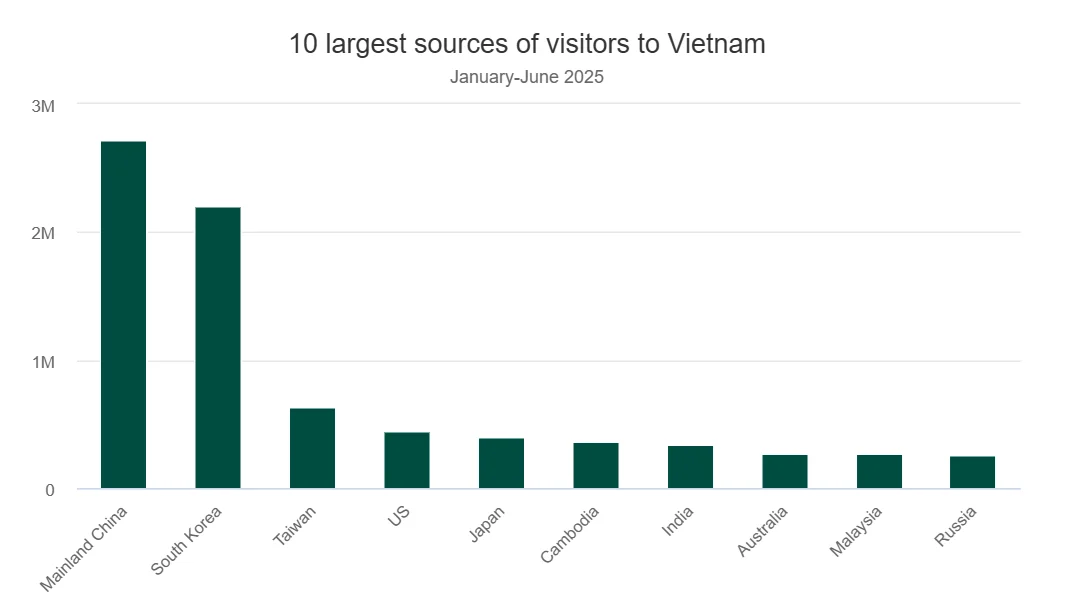
As of June 2025, Vietnam’s General Statistics Office reports that China has surpassed South Korea as its biggest source market; at the time, Vietnam welcomed 1.95 million Chinese arrivals out of the 7.7 million foreigners who entered the country throughout Q1-2025.
This 15 percent increase in Chinese tourists from totals recorded in 2019 are seen as proof positive of Vietnam’s ongoing drive to draw in more foreign arrivals.

The Vietnam advantage
Experts point out that there are numerous reasons why Vietnam is rapidly rising through the ranks to become Southeast Asia’s next most likely tourism hotspot.
One report points out the obvious: the country’s rich natural beauty is certainly a draw in and of itself, and, when paired with the richness of Vietnam’s diverse cultural heritage and affordable costs for food, lodging, and transportation, it becomes a formula for promotional success.
Vietnam has also been actively ramping up its infrastructure to aid both locals and tourists, bringing in investments for the development of hotels, resorts, overall connectivity, and attractions, as well as for access roads, sea ports, and airport development as seen in the soon-to-be-opened Long Thanh International Airport on the southern outskirts of Ho Chi Minh City
The country’s drive towards more sustainable, even regenerative tourism options has also boosted its appeal, and its government’s measures to protect both the environment and intangible heritage assets have been lauded globally.

Specific aspects drawing in Chinese travellers
While improved infrastructure has been a great help in boosting Vietnam’s profile as a tourist destination not just for the Chinese but also for the rest of the world, it also has several factors working in its favour.
Consider this: Vietnamese tourism and hospitality firms are hiring or training more Mandarin-speaking staff to deal with the growing number of Chinese travellers coming into the country.
At the same time, Vietnamese professionals have studied this particular market carefully, resulting in itineraries specifically tailored to the tastes of both adventure-seekers and those opting for a more leisurely way of travelling the country.
Social media, specifically China-centric platforms like WeChat, Xiaohongshou, and Weibo which are also available in Vietnam, has also served as a promotional tool targeting younger, more adventurous travellers.
Let us also consider another aspect: Vietnam’s rising presence in the field of luxury travel and hospitality.
Over the past year, we have noted the construction of luxury accommodations brought in by major global brands, including Ritz-Carlton, Capella, and The Luxury Collection.
Luxurious stays paired with the country’s status as one of Asia’s top golf destinations have likewise helped draw in high net worth travellers from the Chinese Mainland, as well as from Hong Kong and Macao.
We should also not discount the fact that, due to the aforementioned sociopolitical and security issues, Chinese travellers feel safer in Vietnam than in other parts of the region, citing a shared heritage and history, along with stronger diplomatic ties.
While we may still be in the earliest days of 2026, Vietnam’s appeal to the Chinese travellers may already be here for the long haul.