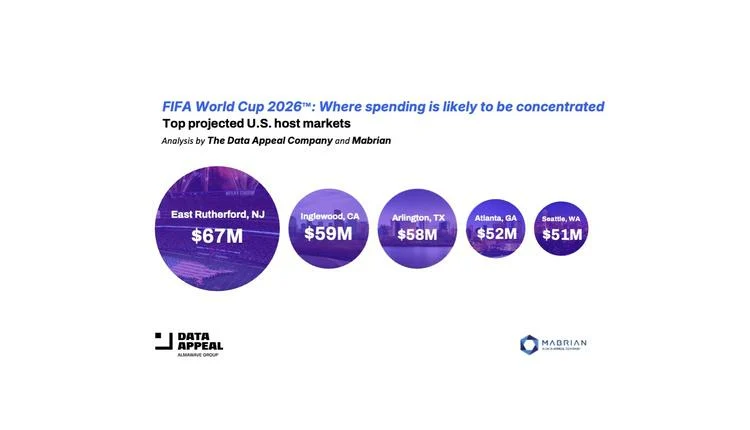
The upcoming FIFA World Cup 2026 is set to generate an estimated $556 million in event-related spending across US host cities, according to a pre-event economic impact analysis by The Data Appeal Company and Mabrian. This projection, unveiled on 17 February 2026, suggests that spending will be concentrated in cities with high attendance potential, large stadiums, robust hospitality infrastructure, and direct air connectivity.
The analysis identifies East Rutherford, New Jersey, as the leading beneficiary, expected to receive $67 million in spending. Other top cities include Inglewood, California ($59 million), Arlington, Texas ($58 million), Atlanta, Georgia ($52 million), and Seattle, Washington ($51 million). These five cities alone are projected to account for 52% of the total spending.
Mirko Lalli, CEO and Founder of The Data Appeal Company, noted that "Food & beverage represents the largest spending category, projected at $280 million, accounting for 50% of total spend." Accommodation and transportation follow, with projected spends of $181 million and $95 million, respectively.
The analysis also highlights the evolving nature of travel behaviour, with many fans delaying travel decisions until team qualifications are finalised. The United States, with direct air connectivity from all qualified markets, is expected to see a 3.3% increase in seat capacity year over year.
Carlos Cendra, Director of Marketing and Communications at Mabrian, stated, “Air scheduling for 2026 is still at a very early stage and will continue to evolve.” The final playoff matches in March are expected to further influence air connectivity patterns.
Overall, the World Cup is poised to have a significant economic impact on US host cities, with spending driven primarily by destination-based visitor activity
This story was selected and published by a human editor, with content adapted from original press material using AI tools. Spot an error? Report it here.