New-York Historical Society explores the bygone landmarks and sites of 'Lost New York'

Travel Daily Media

TDM AWARDS - NOMINATE NOW!

New-York Historical Society explores the bygone landmarks and sites of ‘Lost New York’

This spring, the New-York Historical Society debutsย Lost New York,ย a new exhibition exploring the places that once defined New York City. On view April 19 โ€“ September 29, 2024, the exhibition invites visitors to experience the cityโ€™s lost landmarks, such as the original Penn Station, Croton Reservoir, Chinese Theater, and river bathhouses. Throughout the exhibition, community voices bring these lost sites to life: a woman recalls attending the Old Met Opera House in 1939, a Broadway carpenter reminisces about a photograph of his father in front of the Hippodrome Theatre, and a choir director reflects upon the demolished Harlem Renaissance monumentย Lift Every Voice and Sing. Curated by Wendy Nฤlani E. Ikemoto, vice president and chief curator of New-York Historical,ย Lost New Yorkย showcases treasures from the Museum and Patricia D. Klingenstein Library collections and captures both the dynamism of an ever-changing city and the importance of preserving pieces of our otherwise vanishing past.

To welcome the new exhibition, pay-as-you-wish Friday evenings will expand from 5โ€“8 pm and include live vintage music and specialty โ€œlostโ€ cocktails during the spring and summer months.

โ€œLost New Yorkย invites visitors to wander through the echoes of a city unfamiliar to what they know now,โ€ said Dr. Louise Mirrer, president and CEO of New-York Historical. โ€œWeโ€™re excited to welcome visitors throughout the run of the exhibition and especially on Friday nights when the galleries will be filled with vibrant music, nostalgia, and good cheer.โ€

โ€œLost New Yorkย delves into the many and deep layers of this city. I hope visitors will delight in discovering the landmarks that once defined the places they know but also consider the serious issues, like gentrification and environmental devastation, that drove their loss and reflect upon the importance of preserving our past,โ€ said Dr. Wendy Nฤlani E. Ikemoto. โ€œIt has been an honor to connect with members of our community and learn about their experiences with these lost places. Their voices enliven and personalize the exhibition and sustain the memory and meaning of these sites.โ€

Exhibition Highlights
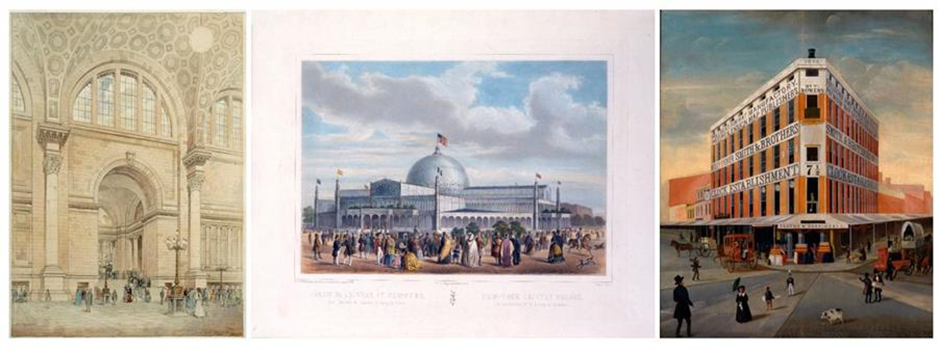
Comprising more than 90 paintings, photographs, objects, and lithographs, the exhibition offers captivating glimpses into the cityโ€™s rich architectural heritage and vibrant past. Featured is Jules Crowโ€™s vivid depiction of the Pennsylvania Station Interior in 1906, a masterful watercolor capturing the grandeur of the original Beaux-Arts masterpiece designed by McKim, Mead, and White. Opened in 1910, the building stood for only 54 years. Its demolition spurred the creation of the New York City Landmarks Preservation Commission two years later.

Capturing another bygone structure is Franรงois Courtinโ€™s lithograph displaying the grandeur of New Yorkโ€™s Crystal Palace during the 1853 Exhibition of the Industry of All Nations. Rising majestically in what is now Bryant Park, this architectural marvel once hosted technological wonders from across the globe, offering a glimpse into an era of innovation and boundless imagination. Steps away was the original Croton Reservoir, built to increase the cityโ€™s water supply, as depicted in an 1850 lithograph by Charles Autenrieth. Its massive Egyptian-style walls became a popular promenade spot for New Yorkers. Parts of the original stone structure can still be seen on the lower level of the New York Public Library on 42nd Street, which rose in its place.

While sign painter De La Prelette Wriley shows off his own business in the 1837 oil on wood panel,ย No. 7 1/2 Bowery,ย the painting features another antiquated hallmark of early New Yorkโ€”a pig roaming the streets. A low-maintenance and high-protein food staple, pigs wandered freely through the city until 1859, serving as New Yorkโ€™s first garbage management system by eating scraps off the streets. Showcasing another common animal of the cityโ€™s early streets, William Seamanโ€™s 1850 oil paintingย Knickerbocker Stage Line Omnibusย depicts New Yorkโ€™s first form of mass transit: large horse-drawn stagecoaches that carried about a dozen people at a time and ran along designated routes.

Complementing many of the works on display are observations from a variety of New Yorkers sharing their memories of the places depicted. These community voices include an artist who, as an LGBTQ+ youth and aspiring artist, purchased a t-shirt from Keith Haringโ€™s Pop Shop; a woman from a self-described multigenerational family Yankee โ€œfandomโ€ who remembers watching David Wells and David Cone pitch perfect games at the old Yankee Stadium; and a cultural worker who imagines the cross-cultural conversation that led Samuel Northcote to mistitle New York Cityโ€™s first Chinese-language theater in his 1899 painting of it.

Programming
Starting on May 3 and continuing every Friday through early summer, pay-as-you-wish Friday nights expand, beginning at 5pm and lasting until 8pm. Visitors can enjoy a live band playing classic jazz and American standards and a bar featuring classic and forgotten NYC cocktails.

On May 20,ย New York Timesย writer Brent Staples reveals the extraordinary story of Elizabeth Gloucester, who was born into slavery; as a free woman became a well-connected champion of the anti-slavery movement in the city; and owned property in Seneca Village, the Black community (featured inย Lost New York)ย whose land New York City seized to make way for Central Park. Tickets forย Elizabeth Gloucester: The Lost Story of New Yorkโ€™s Most Powerful Black Womanย are availableย online.ย Private group toursย can also be arranged throughout the exhibition.

Exhibition-themed story times will also take place on weekends for young visitors, and on April 28, families can learn more about Seneca Village, the day-to-day lives of landowning Black New Yorkers, and the diverse group of people they rented to. For additional details, visit theย family programs calendar.


Join The Community

Join The Community

TDM

x Studio

Connect with your clients by working with our in-house brand studio, using our expertise and media reach to help you create and craft your message in video and podcast, native content and whitepapers, webinars and event formats.

New-York Historical Society explores the bygone landmarks and sites of ‘Lost New York’

This spring, the New-York Historical Society debutsย Lost New York,ย a new exhibition exploring the places that once defined New York City. On view April 19 โ€“ September 29, 2024, the exhibition invites visitors to experience the cityโ€™s lost landmarks, such as the original Penn Station, Croton Reservoir, Chinese Theater, and river bathhouses. Throughout the exhibition, community voices bring these lost sites to life: a woman recalls attending the Old Met Opera House in 1939, a Broadway carpenter reminisces about a photograph of his father in front of the Hippodrome Theatre, and a choir director reflects upon the demolished Harlem Renaissance monumentย Lift Every Voice and Sing. Curated by Wendy Nฤlani E. Ikemoto, vice president and chief curator of New-York Historical,ย Lost New Yorkย showcases treasures from the Museum and Patricia D. Klingenstein Library collections and captures both the dynamism of an ever-changing city and the importance of preserving pieces of our otherwise vanishing past.

To welcome the new exhibition, pay-as-you-wish Friday evenings will expand from 5โ€“8 pm and include live vintage music and specialty โ€œlostโ€ cocktails during the spring and summer months.

โ€œLost New Yorkย invites visitors to wander through the echoes of a city unfamiliar to what they know now,โ€ said Dr. Louise Mirrer, president and CEO of New-York Historical. โ€œWeโ€™re excited to welcome visitors throughout the run of the exhibition and especially on Friday nights when the galleries will be filled with vibrant music, nostalgia, and good cheer.โ€

โ€œLost New Yorkย delves into the many and deep layers of this city. I hope visitors will delight in discovering the landmarks that once defined the places they know but also consider the serious issues, like gentrification and environmental devastation, that drove their loss and reflect upon the importance of preserving our past,โ€ said Dr. Wendy Nฤlani E. Ikemoto. โ€œIt has been an honor to connect with members of our community and learn about their experiences with these lost places. Their voices enliven and personalize the exhibition and sustain the memory and meaning of these sites.โ€

Exhibition Highlights
Comprising more than 90 paintings, photographs, objects, and lithographs, the exhibition offers captivating glimpses into the cityโ€™s rich architectural heritage and vibrant past. Featured is Jules Crowโ€™s vivid depiction of the Pennsylvania Station Interior in 1906, a masterful watercolor capturing the grandeur of the original Beaux-Arts masterpiece designed by McKim, Mead, and White. Opened in 1910, the building stood for only 54 years. Its demolition spurred the creation of the New York City Landmarks Preservation Commission two years later.

Capturing another bygone structure is Franรงois Courtinโ€™s lithograph displaying the grandeur of New Yorkโ€™s Crystal Palace during the 1853 Exhibition of the Industry of All Nations. Rising majestically in what is now Bryant Park, this architectural marvel once hosted technological wonders from across the globe, offering a glimpse into an era of innovation and boundless imagination. Steps away was the original Croton Reservoir, built to increase the cityโ€™s water supply, as depicted in an 1850 lithograph by Charles Autenrieth. Its massive Egyptian-style walls became a popular promenade spot for New Yorkers. Parts of the original stone structure can still be seen on the lower level of the New York Public Library on 42nd Street, which rose in its place.

While sign painter De La Prelette Wriley shows off his own business in the 1837 oil on wood panel,ย No. 7 1/2 Bowery,ย the painting features another antiquated hallmark of early New Yorkโ€”a pig roaming the streets. A low-maintenance and high-protein food staple, pigs wandered freely through the city until 1859, serving as New Yorkโ€™s first garbage management system by eating scraps off the streets. Showcasing another common animal of the cityโ€™s early streets, William Seamanโ€™s 1850 oil paintingย Knickerbocker Stage Line Omnibusย depicts New Yorkโ€™s first form of mass transit: large horse-drawn stagecoaches that carried about a dozen people at a time and ran along designated routes.

Complementing many of the works on display are observations from a variety of New Yorkers sharing their memories of the places depicted. These community voices include an artist who, as an LGBTQ+ youth and aspiring artist, purchased a t-shirt from Keith Haringโ€™s Pop Shop; a woman from a self-described multigenerational family Yankee โ€œfandomโ€ who remembers watching David Wells and David Cone pitch perfect games at the old Yankee Stadium; and a cultural worker who imagines the cross-cultural conversation that led Samuel Northcote to mistitle New York Cityโ€™s first Chinese-language theater in his 1899 painting of it.

Programming
Starting on May 3 and continuing every Friday through early summer, pay-as-you-wish Friday nights expand, beginning at 5pm and lasting until 8pm. Visitors can enjoy a live band playing classic jazz and American standards and a bar featuring classic and forgotten NYC cocktails.

On May 20,ย New York Timesย writer Brent Staples reveals the extraordinary story of Elizabeth Gloucester, who was born into slavery; as a free woman became a well-connected champion of the anti-slavery movement in the city; and owned property in Seneca Village, the Black community (featured inย Lost New York)ย whose land New York City seized to make way for Central Park. Tickets forย Elizabeth Gloucester: The Lost Story of New Yorkโ€™s Most Powerful Black Womanย are availableย online.ย Private group toursย can also be arranged throughout the exhibition.

Exhibition-themed story times will also take place on weekends for young visitors, and on April 28, families can learn more about Seneca Village, the day-to-day lives of landowning Black New Yorkers, and the diverse group of people they rented to. For additional details, visit theย family programs calendar.


Join The Community

Stay Connected

Facebook

101K

Twitter

3.9K

Instagram

1.7K

LinkedIn

19.9K

YouTube

0.2K

TDM

x Studio

Connect with your clients by working with our in-house brand studio, using our expertise and media reach to help you create and craft your message in video and podcast, native content and whitepapers, webinars and event formats.

Scroll to Top


