For decades, the rhythm of a Greek summer has followed a predictable script: land in Athens, photograph the Acropolis, board a ferry to the Cyclades. But as visitor numbers surge and island ports strain under peak-season crowds, a quieter shift is taking place along the mainland coast.
Just an hour west of the capital, the Corinthian coastline offers something different. Here, on the edge of the Saronic Gulf, the landscape feels raw and elemental. Pebble coves replace sandy party beaches. Low mountains roll into the sea. The air occasionally carries the faint scent of sulphur from the dormant Sousaki volcano, a geological reminder that myth and earth are tightly intertwined in this part of Greece. This is a region shaped as much by legend as by light. Ancient Corinth, once one of the most powerful city-states in the classical world, lies a short drive away. Inland villages hum with agricultural life. And yet, for years, many international travellers simply passed through, en route to somewhere else.
Greece’s Tourism Boom and Search for Space
Greece welcomed more than 32 million international visitors in 2023, generating over €20 billion in tourism revenue, according to the Bank of Greece. Athens in particular has experienced record growth, with Athens International Airport reporting one of its busiest years in 2024. The islands remain the poster image of the country, but conversations around overtourism have become louder, especially during high summer. In response, both travellers and tourism authorities are looking beyond the obvious. Mainland coastal regions near the capital are benefiting from this recalibration. They offer accessibility without the logistical choreography of ferries and domestic flights, and a sense of space that feels increasingly rare in peak season.
Corinthia fits neatly into this emerging narrative. It delivers the Greek essentials, sea, ruins, tavernas, sun-bleached landscapes, but without the pressure to perform for social media.
Beyond the Pool: What to Explore in Corinthia
One of the most dramatic sights in the region is the Corinth Canal. Carved through solid rock in the late 19th century, this narrow waterway slices the Isthmus of Corinth in two, linking the Aegean and Ionian seas. Standing on the bridge and looking down at the sheer limestone walls plunging nearly 80 metres to the water below is a vertigo-inducing experience. For the brave, there is even bungee jumping from the bridge, a sharp contrast to the otherwise slow rhythm of the coast. A short drive away lie the ruins of Ancient Corinth, where columns from the Temple of Apollo still stand against a backdrop of mountains. Wandering through the archaeological site, with views stretching towards the sea, places modern-day beach life into a much longer historical context. Above it all rises Acrocorinth, the fortified hilltop that once guarded the city and rewards those who climb it with sweeping panoramas of the Gulf.
For nature lovers, Lake Vouliagmeni, not to be confused with its Athenian namesake, is a serene lagoon connected to the sea by a narrow channel. Fringed by tavernas and low cliffs, it is ideal for a languid lunch followed by an unhurried swim. Along the wider Corinthian Gulf, small beaches such as Kalamia and quieter pebble coves near Loutraki offer clear water without the choreography of organised island beach clubs. Loutraki itself has long been known for its thermal springs, drawing visitors seeking restorative waters since antiquity. Today, it remains a relaxed seaside town where morning walks along the promenade and simple seafood dinners feel refreshingly unpretentious.
Further afield, wine estates in the Nemea region invite detours inland. This is one of Greece’s most important appellations, known for the Agiorgitiko grape. Tastings here add another layer to the idea of slow travel, afternoons spent moving between vineyards rather than ticking off landmarks.
A Landscape of Lava and Light
The presence of Sousaki, a craterless volcano dormant for millions of years, adds an unexpected geological layer to the region. In ancient mythology, the giant Typhoeus was said to lie buried beneath this terrain, his restless energy shaping the land. Whether taken literally or symbolically, the myth mirrors the physical drama of the coastline. Yet the experience here is not dramatic in pace. It is deliberate. This is a place for slow mornings on a lounger, for reading without interruption, for watching the sea shift from cobalt to silver as the sun drops.

Design as an Extension of Place
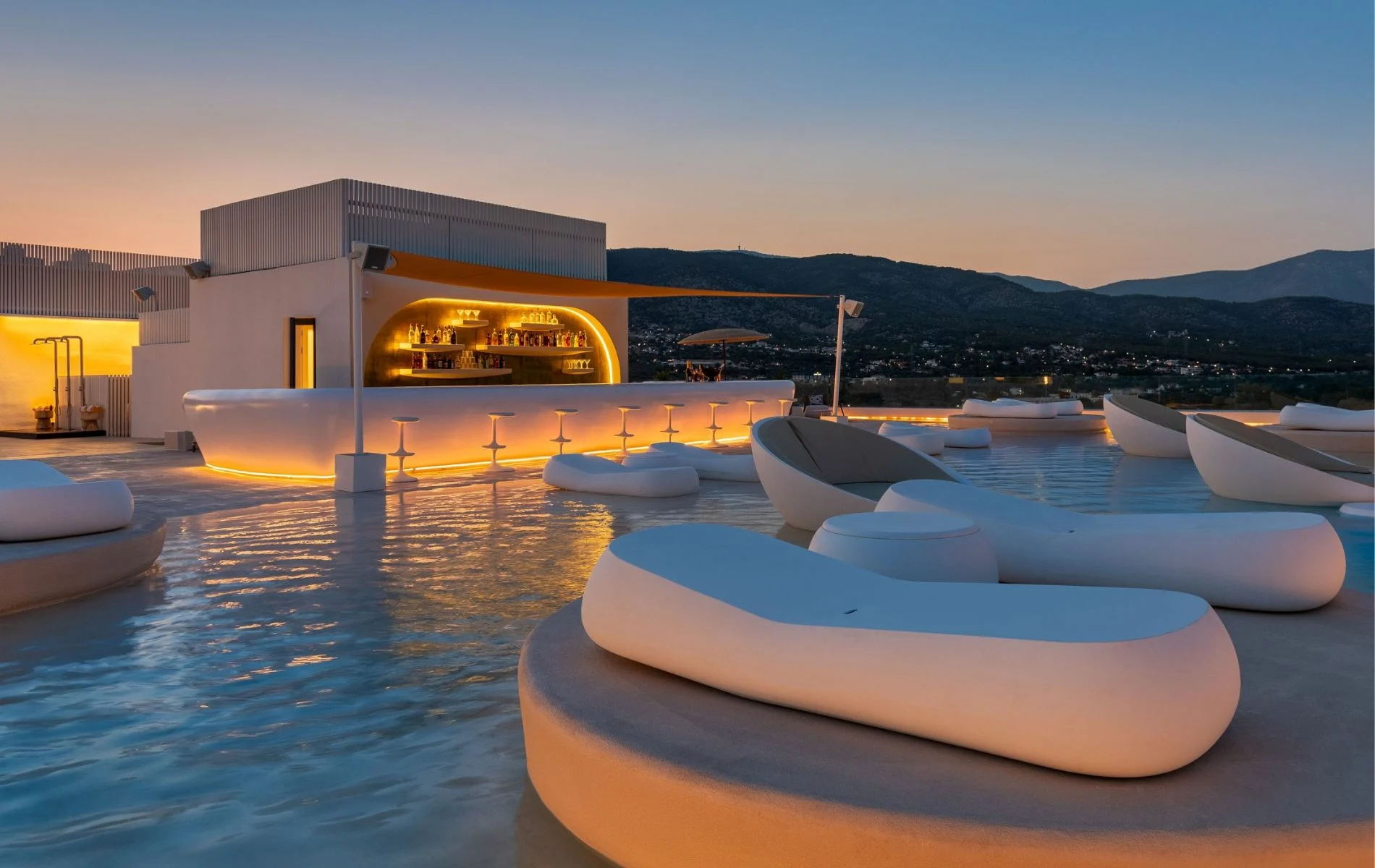
Within this evolving destination story sits Isla Brown Corinthia Resort & Spa, a design-led retreat that mirrors the region’s geological and mythic cues rather than competing with them. Originally a 1970s structure, the building was reimagined with fluid, sculptural lines that echo stacked pebbles and molten forms. The architecture appears to rise organically from the coastline, its palette anchored in stone, sand and muted earth tones. Interiors follow the same philosophy, curved surfaces, tactile materials and wide openings that frame uninterrupted views of the Saronic Gulf.
The hotel’s 166 rooms and suites are oriented towards sea or mountain, each with expansive balconies that blur the boundary between indoors and out. The rooftop terrace, with its small pool and wide views, feels more contemplative than celebratory. A cave-style bar nods to the region’s volcanic mythology, while the wellness centre draws inspiration from the mineral and geothermal character of the surrounding landscape. Importantly, the property functions as a base rather than a bubble. Days can alternate between archaeological exploration, canal viewpoints, lagoon swims and vineyard visits before returning to the calm of the coast.
The Smarter Alternative
As summer itineraries grow more ambitious and flights more expensive, proximity has become a form of luxury. Being able to leave Athens in the late morning and be swimming in the Corinthian Gulf by lunchtime is part of the appeal. There is no ferry timetable to negotiate, no island transfer to coordinate. For travellers recalibrating their relationship with Greece, trading high-energy hotspots for considered calm, this stretch of mainland coast offers a persuasive argument. It captures the mythology, the sea, the design sensibility and the culinary pleasure that define the country, but reframed through a slower lens.
In a year when Greece continues to post record tourism numbers, the real luxury may not be another island stamp in the passport, but the decision to stay closer, linger longer and rediscover the mainland.