


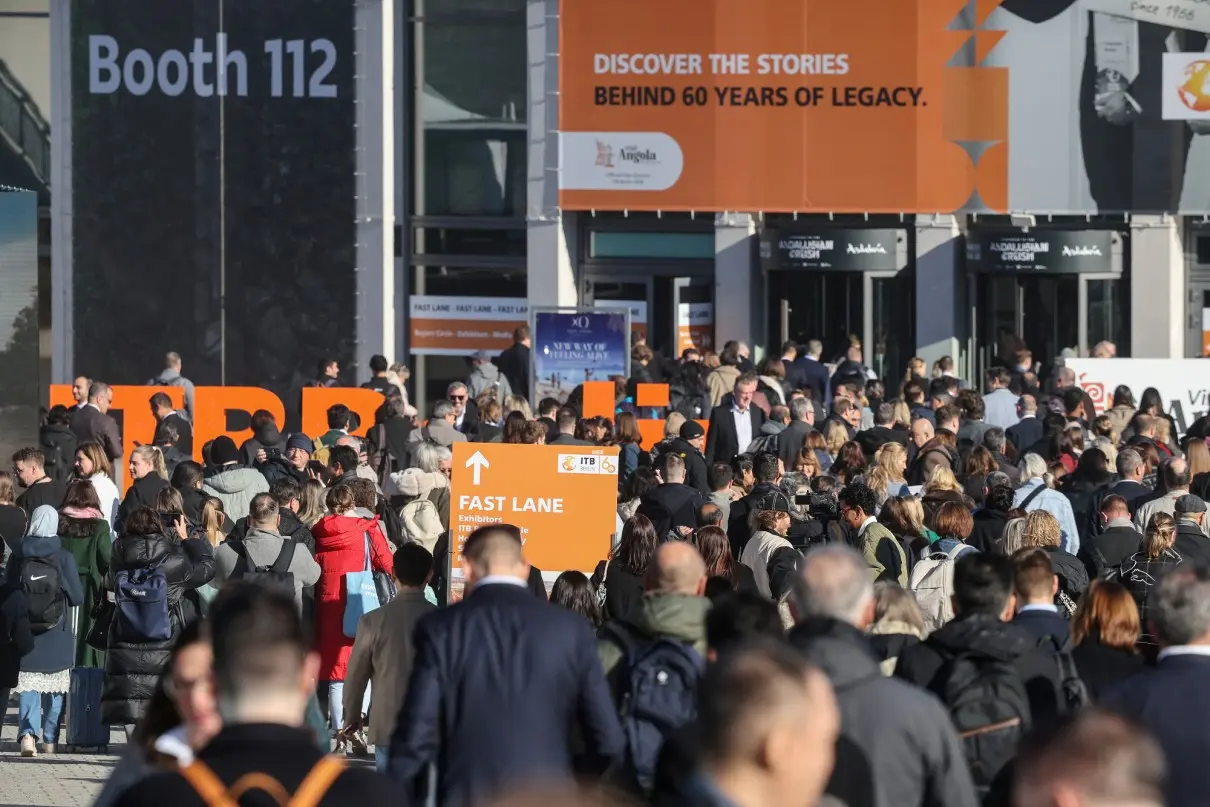
 ITB Berlin 2026: The industry sets an example for dialogue and resilience in uncertain times. Copyright: ITB Berlin
Global travel trade exhibitions are entering a new phase of growth, with attendance, buyer participation and scheduled meetings suggesting that the industry’s biggest marketplaces have lost little of their commercial pull despite the rise of virtual meetings and digital distribution. The evidence was particularly visible at ITB Berlin in March. Marking its 60th anniversary, the show drew nearly 97,000 attendees and 5,601 exhibitors from 166 countries. Visitor numbers remained close to the previous year despite flight disruption linked to conflict in the Middle East. The scale is striking when set against ITB’s beginnings in 1966, when just nine exhibitors from five countries and 250 trade visitors attended the first event.
Madrid’s FITUR has similarly developed into one of the industry's largest international gatherings, particularly for Europe and Latin America. In the Middle East, the expansion has been just as pronounced. Arabian Travel Market brought together around 55,000 travel professionals and a record 2,800 exhibitors in Dubai in 2025, according to the Dubai Government Media Office.
The resilience of these shows matters because large physical exhibitions were supposed to be among the casualties of travel's digital transformation. Video meetings became routine during the pandemic; contracting, distribution and product launches moved online; and corporate travel budgets came under closer scrutiny.
Yet the major exhibitions have not disappeared. They have become more transactional.
And that raises a more demanding question for tourism boards, hotel groups, airlines, DMCs, travel technology companies and tour operators: does the cost of being there translate into business?
The exhibition floor becomes a marketplace
Footfall remains useful for organisers. For exhibitors, it is increasingly the wrong measure. The more telling numbers are qualified buyers, scheduled appointments and the business pipeline generated after the halls close. WTM London illustrates the shift. Its 2025 edition attracted 46,500 attendees, including 5,500 qualified buyers, while confirmed pre-scheduled meetings rose 30% to more than 40,000. Organisers estimated that those meetings would generate more than £2.2 billion in business deals.
That £2.2 billion is an organiser estimate rather than independently audited sales revenue, an important distinction when assessing exhibition ROI. But the growth in scheduled meetings says something about how the model is changing. Companies increasingly want to know who they will meet before they board the flight. Specialist events take that approach further.
ILTM Cannes, focused on luxury travel, reported more than 100,000 scheduled meetings at its 2025 edition, connecting more than 2,500 buyers from 83 countries with over 2,350 brands. Almost 10,000 people attended.
For the meetings and events sector, IMEX Frankfurt generated more than 67,000 pre-scheduled meetings over three days in 2025. The event attracted more than 13,000 participants, including over 4,000 buyers. One-to-one meetings increased 10% from the previous year.
For a hotel group, DMC or emerging travel technology company, that concentration of buyers can be difficult to reproduce through individual sales trips. A productive three-day show can put dozens of existing and prospective partners within walking distance.
But only if the right people are in the diary.
Business is only part of the return
There is another reason exhibitions have proved difficult to replace: not all their value ends in a signed contract. Research published in the Journal of Hospitality and Tourism Management examined 416 exhibiting companies and found that exhibitors' networking capabilities influenced both exploratory and exploitative learning. Those learning behaviours, in turn, affected how effectively companies gathered information at trade shows.
For travel businesses, that intelligence can be commercially significant. A tour operator may identify changing demand for a destination before it appears clearly in booking data. A hotel can hear directly from buyers where pricing is meeting resistance. Tourism boards can test perceptions of new markets, while technology suppliers get immediate feedback on whether an innovation solves a genuine industry problem.
There is a longer-term relationship effect too. Research published in Industrial Marketing Management, based on 414 exhibitor-visitor relationships, found a strong connection between relationship learning at trade shows and subsequent relationship performance.
Another Industrial Marketing Management study examined B2B trade fairs through a relationship-marketing lens and found that information exchange can build trust, while social interaction can strengthen satisfaction and commitment between buyers and suppliers.
That helps explain why Zoom has not killed the exhibition. Digital meetings are efficient when both parties already know what they want to discuss. Trade shows are better suited to the less predictable part of business — discovering a potential partner, picking up intelligence over coffee, seeing what competitors are selling or turning a weak contact into a serious relationship.
Which travel shows matter most?
There is no meaningful global ranking without considering what a company sells and where it wants to grow.
ITB Berlin and WTM London remain among the broadest international B2B marketplaces, bringing together destinations and businesses from across the tourism value chain. FITUR has particular relevance for companies targeting Spain, Europe and Latin America, while Arabian Travel Market has gained weight alongside the Gulf's rapid expansion in aviation, hospitality, destination development and outbound travel.
For luxury operators, ILTM Cannes can be commercially more relevant than a much larger general travel exhibition because of its concentration of specialist buyers. IMEX Frankfurt plays a comparable role for meetings, incentives, conferences and events.
Increasingly, relevance beats size.
A DMC seeking luxury travel advisers from North America may gain more from 30 carefully selected appointments at ILTM than from thousands of visitors walking past a stand elsewhere. A hotel targeting corporate meetings buyers may find IMEX delivers the stronger pipeline. An Asian destination seeking European tour operators could make a different calculation.
Bigger stands do not necessarily mean better returns
The cost question is becoming harder to ignore. Exhibition participation can involve stand rental and construction, flights, hotels, entertainment, staffing and several days of executive time. For national tourism organisations and large hotel groups, the investment can be substantial.
Yet spending more does not guarantee better performance. A 2020 study in the International Journal of Hospitality Management, examining exhibitor performance at an international travel fair, found that exhibitors could reduce resources while maintaining outputs. Its analysis suggested that bigger was not necessarily better and identified scope to reduce booth area, rental costs, set-up expenditure and on-site staffing while improving efficiency.
That finding goes to the heart of the modern exhibition debate. The strongest return may have less to do with the size of the stand than the quality of the appointment book. Exhibitors need clear target markets, qualified prospects, meetings arranged before arrival and disciplined follow-up once the event ends. Leads that sit untouched for three weeks are unlikely to justify an expensive presence in Berlin, London, Madrid, Dubai or Cannes.
Trade exhibitions have survived because travel remains a relationship business. Their role, however, is changing. They are no longer simply annual gatherings where destinations need to be seen because competitors are there. As marketing and travel budgets face closer scrutiny, the pressure will increasingly be on organisers to deliver qualified buyers — and on exhibitors to demonstrate what those meetings produced.
The exhibition itself is only three or four days. The real measure of its relevance comes months later: which conversations moved into the sales pipeline, which relationships deepened, what market intelligence changed a commercial decision — and, ultimately, which meetings turned into business.





